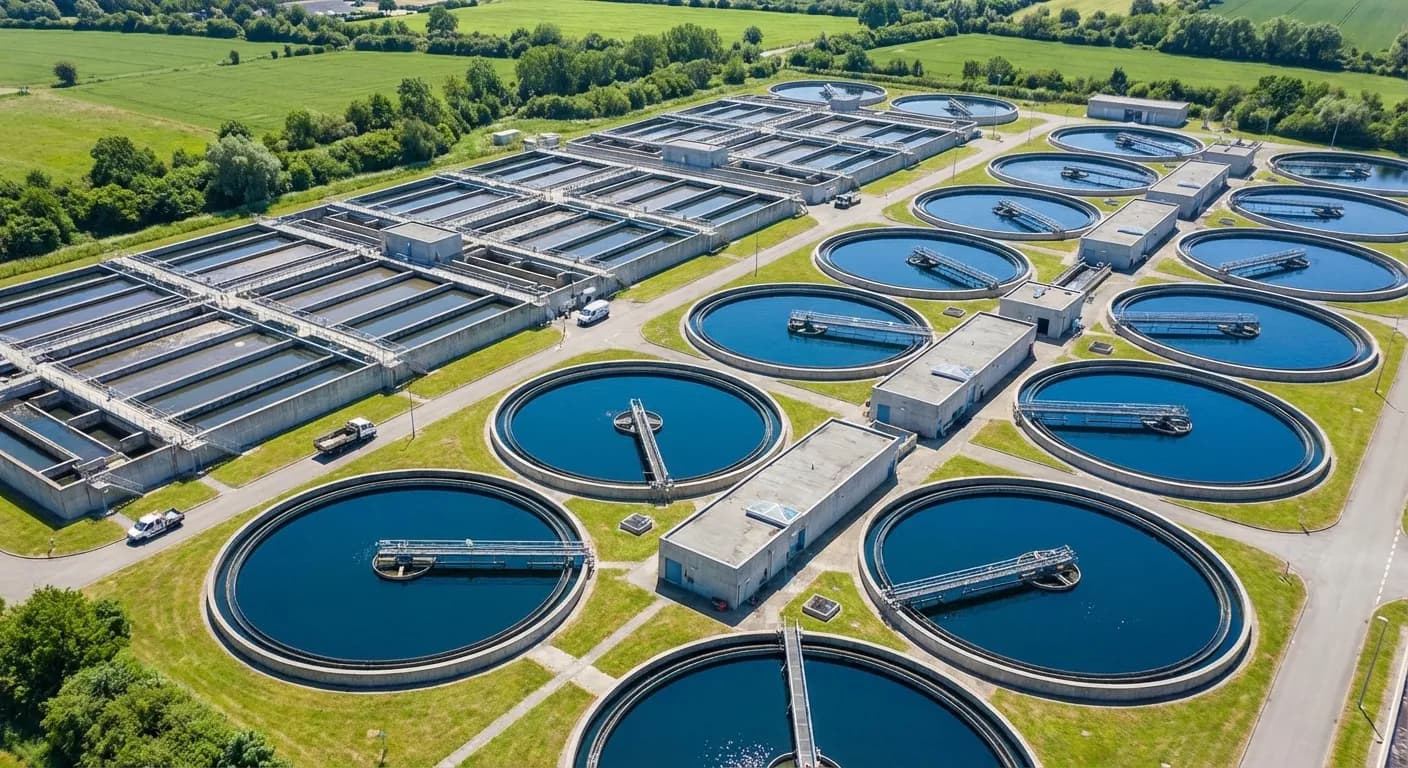
Ferric chloride removes phosphorus by precipitating dissolved orthophosphate as insoluble ferric phosphate (FePO₄) plus co-precipitation onto ferric hydroxide flocs. Practical dosing is set as a molar ratio of iron to phosphorus: about Fe:P 1.0–1.5 for effluents around 1 mg/L P, rising to 2.0–4.0 or more below 0.5 mg/L P, always confirmed by jar testing on the actual wastewater.
The chemistry in one paragraph
Dosed into wastewater, Fe³⁺ reacts with orthophosphate to form ferric phosphate, while excess iron hydrolyses to ferric hydroxide that adsorbs additional phosphorus species and sweeps fine solids. The reaction is fast — seconds at a good mixing point — and works across a wide pH window with an optimum near pH 5.5–7.0 for FePO₄ formation. Only ortho-phosphate precipitates directly; polyphosphates and organic phosphorus must first hydrolyse biologically, which is why dosing point selection matters as much as dose.
Why the dose is a ratio, not a number
At an exact stoichiometric 1:1 molar ratio, removal is incomplete — competing reactions (hydroxide formation, carbonate, organics) consume iron. The lower the phosphorus target, the more "excess" iron the equilibrium demands:
| Effluent total-P target | Typical Fe:P molar ratio | Notes |
|---|---|---|
| ~2 mg/L | 0.8–1.2 | Coarse trim; co-precipitation does much of the work |
| ~1 mg/L | 1.0–1.5 | Common municipal consent level |
| ~0.5 mg/L | 1.5–2.5 | Needs good solids capture downstream |
| <0.3 mg/L | 2.5–4.0+ | Usually two-point dosing + filtration/polishing |
Converting ratio to a product dose — worked example
Commercial ferric chloride is a 40% FeCl₃ solution. FeCl₃ is 34.4% iron by mass, so the solution carries ≈13.8% Fe w/w — with density ~1.43 kg/L, about 197 g of iron per litre of product.
Say influent ortho-P to the dosing point is 6 mg/L and the consent is 1 mg/L: you must precipitate ~5 mg/L P. At Fe:P = 1.5 (molar), the iron demand is 1.5 × (55.85/30.97) × 5 ≈ 13.5 mg/L Fe, which is ≈ 39 mg/L as FeCl₃, or ≈ 98 mg/L as 40% product: roughly 0.07 mL of 40% product per litre — about 70 L of product per 1,000 m³ treated. That lands inside the 20–200 mg/L commercial-dose window on the product TDS, and the jar test then trims it to your water. Our guide to ferric chloride dosing explains the dose units and how to turn a dose into a pump setting.
Where to dose
- Pre-precipitation (primary clarifier inlet): cuts load to the biology, biggest sludge production, protects against peaks.
- Simultaneous precipitation (into the aeration basin / RAS line): the workhorse — iron recirculates with the sludge and keeps working; lowest total dose for most plants.
- Post-precipitation (before a tertiary clarifier or filter): for tight limits; cleanest control loop, needs its own solids separation.
- For limits below ~0.3 mg/L, combine two dosing points and a polishing filter rather than forcing one point to a brutal ratio.
Side effects to engineer around
Alkalinity: every mg/L of FeCl₃ consumes ≈0.9 mg/L alkalinity as CaCO₃. Nitrifying plants with thin alkalinity may need lime/caustic support — budget it in the chemical cost comparison. Sludge: chemical sludge adds roughly 1.0–1.5 g of extra dry solids per g of FeCl₃ dosed (ferric phosphate + hydroxide); it is dense and dewaters well, often improving belt-press performance. Iron carryover: with sound solids capture, residual iron stays well below taste/discharge thresholds; spikes mean a solids problem, not a chemistry problem. Materials: 40% ferric chloride is corrosive — HDPE/FRP tanks, lined pumps, and add chemical to water, never water to chemical.
Monitoring that keeps the dose honest
Control on ortho-phosphate at the dosing point (online analysers or grab samples), not just final effluent total-P; track the realised Fe:P weekly and re-jar-test seasonally — temperature and influent character move the curve. Most plants discover 10–20% dose savings in the first optimisation round.