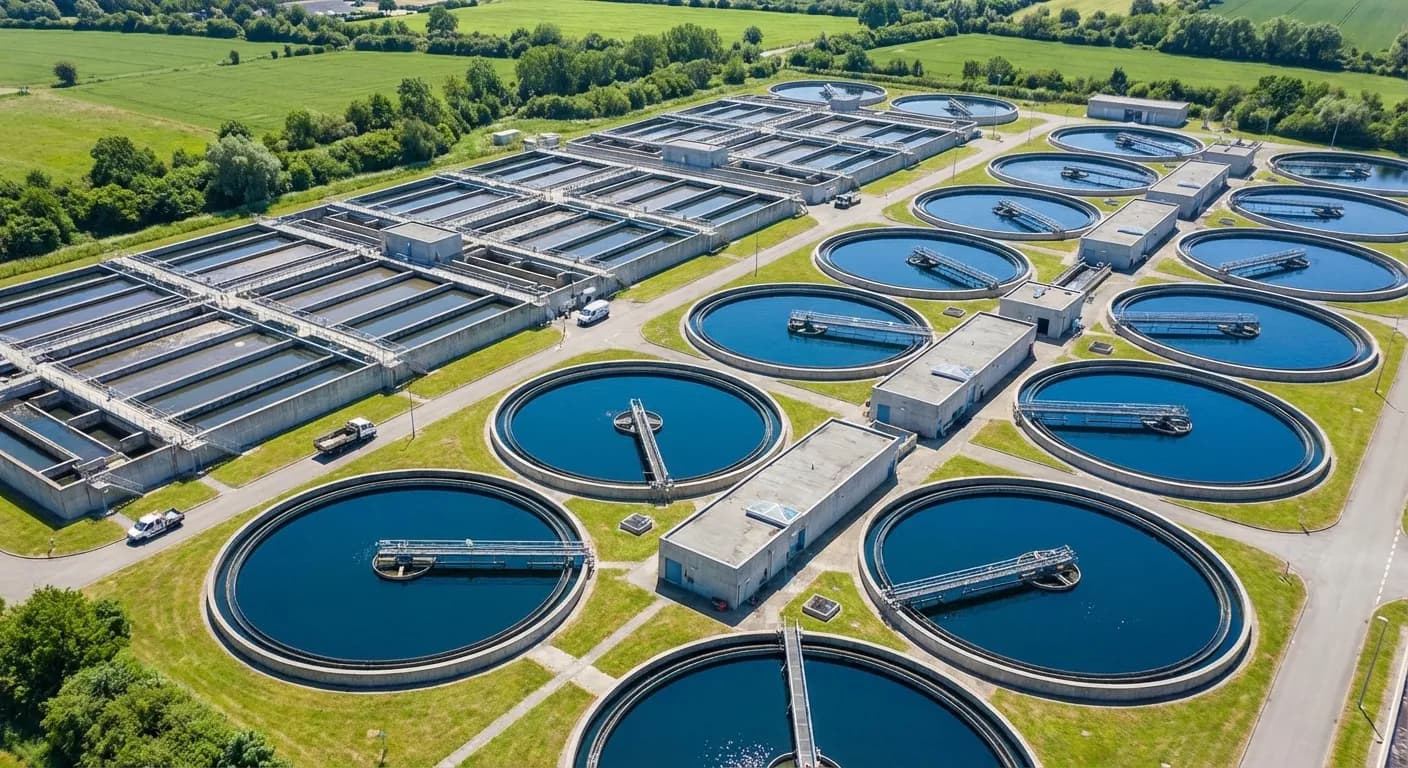
Water treatment chemicals are the reagents dosed into raw water or wastewater to make it fit for its next use — coagulants and flocculants that remove suspended solids, pH adjusters that hold the chemistry in range, disinfectants that inactivate pathogens, and conditioning chemicals that protect boilers and cooling circuits from scale, corrosion and dissolved oxygen. Every treatment train combines several of these classes, and the right products and doses are established the same way everywhere: a water analysis, a jar test, and a supervised plant trial.
What water treatment chemicals actually do
Raw water — whether river water headed for a drinking-water plant, process water feeding a boiler, or effluent leaving a factory — almost never meets its target quality on its own. It carries suspended particles too fine to settle, dissolved contaminants, microorganisms, and dissolved gases. Treatment chemicals attack each of these problems by a different mechanism: destabilising particle charges so solids can be separated, shifting pH so reactions run where they work best, oxidising pathogens, precipitating dissolved metals and phosphorus, or reacting away corrosive oxygen before it reaches boiler steel.
The practical consequence is that no single chemical "treats water." A working plant runs a treatment train — a sequence of physical steps, each enabled by the right chemical at the right point — and the chemicals are chosen as a system, not one by one. This guide walks the train from intake to discharge, describes the six chemical classes that cover most duties, and then sets out the selection, dosing, storage and supplier-evaluation methodology that turns a catalogue into a working chemical program.
The treatment train: where each chemical works
Most clarification-based plants — municipal or industrial, drinking water or effluent — follow the same backbone. Understanding it tells you where every chemical class earns its keep.
1. Coagulation (rapid mix)
Fine particles in water carry a negative surface charge and repel each other, which is why turbidity can stay suspended for days. At the rapid-mix point, a coagulant such as ferric chloride or polyaluminium chloride is dosed under intense mixing — typically a few seconds to a minute — so the metal salt hydrolyses and neutralises those charges before the floc starts forming. Coagulation is the step most sensitive to dose and pH: underdose and particles stay stable; overdose and charges reverse, restabilising the water and wasting chemical.
2. Flocculation
Destabilised particles now need to meet and grow. Flocculation basins apply gentle, tapered mixing — typically tens of minutes — so microflocs collide and build into settleable flocs without shearing apart. This is where a polymeric flocculant is usually added: a long-chain polymer bridges many microflocs into large, dense aggregates that settle far faster than the coagulant alone could achieve.
3. Clarification
Sedimentation basins, lamella clarifiers or dissolved-air-flotation (DAF) units then separate the floc from the water. Chemistry set upstream decides performance here: floc density and size govern settling velocity, and in DAF systems the floc must instead be light and air-attachable. Iron flocs are generally denser than aluminium flocs, which is one of the recurring decision factors in coagulant selection.
4. Filtration
Sand, multimedia or membrane filtration polishes the clarified water, capturing the fine solids that escaped the clarifier. Chemical pretreatment matters twice over: good coagulation upstream extends filter runs, and poorly controlled residual coagulant fouls membranes. Some direct-filtration plants skip clarification entirely and rely on precise, low-dose coagulation straight onto the filters — a mode where a forgiving coagulant and tight dose control are essential.
5. Disinfection
The final barrier for potable and reuse water is disinfection — most commonly chlorination with sodium hypochlorite, dosed to achieve a target residual after a defined contact time. Disinfection efficiency depends on everything upstream: turbidity shields microorganisms from oxidants, which is why regulators treat clarification and disinfection as a linked system rather than independent steps.
6. Beyond the train: boiler and cooling circuits
Utility water inside a plant needs its own chemistry. Boiler feedwater must be freed of dissolved oxygen (oxygen scavengers) and conditioned against scale and carryover; steam condensate is protected with neutralising amines; cooling circuits are dosed with scale and corrosion inhibitors and biocides to keep heat-exchange surfaces clean. These programs run continuously and are usually where a plant's chemical spend is most sensitive to good technical support.
The six classes of water treatment chemicals
Almost every duty on the train above is served by one of six functional classes. The table compares them at a glance; the sections that follow define each class the way an operator meets it.
| Chemical class | What it does | Representative chemicals | Typical dosing point | Key selection criteria |
|---|---|---|---|---|
| Coagulants | Neutralise particle charge; precipitate phosphorus and metals | Ferric chloride (FeCl₃), polyaluminium chloride (PAC), aluminium sulfate, ferrous salts | Rapid mix at plant inlet | Water pH and alkalinity, target contaminant, sludge handling, temperature |
| Flocculants | Bridge microflocs into large, fast-settling or dewaterable flocs | Polyacrylamide (PAM) powders and emulsions, polyamines | Flocculation basin; sludge dewatering | Charge type (cationic/anionic), molecular weight, make-down equipment |
| pH adjusters | Move and hold pH in the window where each step works | Sodium hydroxide (NaOH), sulfuric acid (H₂SO₄), hydrochloric acid (HCl), lime | Before coagulation; final correction; neutralisation | Buffering capacity of the water, materials compatibility, safety |
| Disinfectants / biocides | Inactivate pathogens; control biological growth | Sodium hypochlorite (NaClO), chlorine dioxide, quaternary ammonium biocides | Post-filtration contact tank; cooling circuits | Required residual and contact time, by-product limits, storage stability |
| Scale & corrosion control | Keep dissolved minerals off, and metal on, heat-transfer surfaces | Filming and neutralising amines, sodium nitrite (NaNO₂), inhibitor blends | Boiler feed, condensate, closed and open cooling loops | System metallurgy, temperature, cycles of concentration |
| Oxygen scavengers | Remove dissolved oxygen before it corrodes boiler steel | Hydrazine hydrate (N₂H₄·H₂O), catalysed blends | Deaerator outlet / boiler feed line | Boiler pressure, feedwater temperature, residual control |
Coagulants
A coagulant is an inorganic metal salt — most often an iron(III) or aluminium compound — that destabilises the charged fine particles in water so they can aggregate and be removed. Ferric chloride is an iron(III) salt, typically supplied as a 40% solution (CAS 7705-08-0), that hydrolyses instantly on dosing into ferric hydroxide floc; it is the workhorse for chemical phosphorus removal, high-colour water and sludge conditioning. Polyaluminium chloride (PAC) is a pre-hydrolysed aluminium coagulant, supplied as liquid (typically 10–12% Al₂O₃) or powder (typically 28–30% Al₂O₃), whose partially neutralised chemistry consumes far less alkalinity than alum or ferric — the reason it dominates low-alkalinity and direct-filtration duties. Ferrous salts — ferrous chloride (FeCl₂) and ferrous sulphate — are iron(II) coagulants used in wastewater, H₂S control and chromium-reduction duties where the reduced iron chemistry does double work. The full comparison of when each wins is the subject of our ferric vs PAC vs alum guide, and the complete range is on the coagulants family page.
Flocculants
A flocculant is a high-molecular-weight, water-soluble polymer that bridges coagulated microflocs into large, fast-settling or shear-resistant flocs. Polyacrylamide (PAM, CAS 9003-05-8) is the dominant chemistry, supplied as powder or emulsion in anionic, cationic and non-ionic grades; charge type and molecular weight are matched to the duty, with cationic grades favoured for sludge dewatering and many DAF applications. Flocculants are dosed at far lower rates than coagulants — typically fractions of a mg/L in clarification — but demand careful make-down: the polymer must be dissolved into a dilute stock solution and aged before dosing, or much of its bridging capacity is wasted. Coagulant and flocculant are partners, not substitutes: the coagulant creates something to bridge, the flocculant does the bridging. See the flocculants family page for the grades we manufacture.
pH adjusters and alkalinity control
A pH adjuster is an acid or base dosed to move water into the window where the next treatment step performs — and to correct it back before discharge or distribution. Sodium hydroxide (caustic soda, NaOH) is the most common alkali, typically supplied at 30–50% solution; hydrated lime adds both alkalinity and hardness-precipitation capability. On the acid side, sulfuric acid (H₂SO₄, typically 93–98%) and hydrochloric acid (HCl, typically 30–37%) trim high-pH streams and neutralise alkaline waste. pH control interacts with everything: metal-salt coagulants consume alkalinity as they hydrolyse, so soft, poorly buffered waters often need alkali dosed alongside the coagulant simply to keep the coagulation reaction in its effective window.
Disinfectants and biocides
A disinfectant is an oxidising or biocidal chemical dosed to inactivate pathogens in water or to suppress biological growth in circuits. Sodium hypochlorite (NaClO, CAS 7681-52-9) is the most widely used, typically supplied at 10–15% available chlorine; it is dosed after filtration to achieve a measured free-chlorine residual over a defined contact time. Hypochlorite is also the least stable of the common treatment chemicals — strength declines in storage, faster with heat and light, which is why stock rotation and cool, dark storage are part of the chemistry, not just housekeeping. In cooling systems, non-oxidising biocides such as quaternary ammonium compounds alternate with oxidants to control biofilm without driving resistance.
Scale and corrosion control
A scale inhibitor is a chemical that keeps dissolved minerals from crystallising onto heat-transfer surfaces; a corrosion inhibitor is a chemical that forms or maintains a protective film on the metal itself. In steam systems, neutralising amines travel with the steam and neutralise the carbonic acid that forms in condensate lines, while filming inhibitors protect refinery overheads and process circuits. Closed cooling loops are commonly protected with sodium nitrite (NaNO₂)-based programs, and open recirculating systems combine scale inhibitors, corrosion inhibitors and biocides matched to the water's cycles of concentration. These programs are monitored by residuals and by inspection — coupon racks and boiler blowdown analysis tell you whether the chemistry is actually holding.
Oxygen scavengers
An oxygen scavenger is a reducing chemical dosed into boiler feedwater to react away the last traces of dissolved oxygen that mechanical deaeration leaves behind — the oxygen that would otherwise pit boiler steel at operating temperature. Hydrazine hydrate (N₂H₄·H₂O, CAS 7803-57-8) is the classical high-pressure choice because it adds no dissolved solids to the boiler; it is supplied in grades such as 24% activated and 80% solutions, and catalysed variants react faster at lower feedwater temperatures. Multi-component boiler treatment blends combine oxygen scavenging with sludge conditioning and pH support for smaller industrial boilers where a single-drum program is more practical than three dosing skids.
Selection methodology: analysis, jar test, trial
Choosing water treatment chemicals from a brochure fails often enough that the industry converged on a single defensible method decades ago. It has three steps, in a fixed order.
Step 1 — Characterise the water
Before any product is named, measure the water you actually have, at the worst condition you must treat: flood-season turbidity, winter minimum temperature, weekend load swings. The baseline set is pH, alkalinity, turbidity, temperature, conductivity and the duty-specific targets — phosphorus, COD, colour, hardness, iron and manganese, oil and grease — plus the discharge or product-water limits you must meet. Two numbers do most of the early narrowing: alkalinity (decides whether alkalinity-hungry coagulants need alkali support) and the target contaminant (phosphorus points to iron chemistry; low-alkalinity clarification points to PAC).
Step 2 — Jar test the candidates
The jar test is a bench-scale simulation of the plant: identical beakers of the actual water, a rapid-mix phase, a gentle flocculation phase, and a timed settling phase, with each jar dosed differently. Run candidate chemicals across a dose range — for ferric chloride typically 20–200 mg/L of commercial product — and score settled turbidity, floc formation speed, pH depression, residual metal and sludge volume. The jar test is cheap, fast, and brutally honest: it will contradict the brochure regularly, and it is the evidence a defensible chemical decision rests on. Our practical protocol is written up in jar testing best practices.
Step 3 — Confirm in a plant trial
Jars cannot reproduce real hydraulics, sludge recycle, or week-scale variability, so the winning candidate goes to a supervised plant trial: dose the real stream at the jar-derived rate, hold every other variable steady, and track the plant's own KPIs — settled and filtered turbidity, chemical consumption, sludge production, downstream effects — over enough days to see normal variation. Only then compare economics, and compare them properly: total cost per cubic metre treated, including alkali correction, sludge handling and freight, never price per ton of product alone.
Dosing fundamentals
A correct product at the wrong dose or dosing point performs like the wrong product. Five fundamentals cover most of what goes wrong in practice:
- Know what your dose is expressed in. "100 mg/L of ferric chloride" can mean commercial 40% solution or pure FeCl₃ — a 2.5× difference. State every dose as mg/L of commercial product or mg/L of active substance, explicitly, everywhere: jar sheets, pump settings, consumption reports.
- Convert dose to pump rate through density. Liquid products are pumped by volume but dosed by mass. As a worked example: 100 mg/L of commercial ferric chloride solution into 100 m³/h of water is 10 kg/h of product — at a specific gravity of roughly 1.40–1.45, approximately 7 L/h on the dosing pump. Verify the actual delivery by drawdown cylinder, not by the pump's dial.
- Respect the mixing point. Coagulants need intense mixing at the instant of dosing — inject into a flash mixer or a point of high turbulence, never into a stagnant corner of a channel. Flocculants need the opposite: gentle mixing after a short maturation, or the shear tears the flocs the polymer just built.
- Make polymers down properly. Powder flocculants are typically dissolved to a 0.1–0.5% stock solution, aged 30–60 minutes, then diluted further at the injection point; skipping the ageing step is the most common cause of "the polymer doesn't work". Confirm make-down concentrations against the product's technical data sheet.
- Close the loop with measurement. Dose to a measured signal — settled turbidity, orthophosphate at the dosing point, chlorine residual, scavenger residual in the boiler — and re-jar-test seasonally. Raw water changes; a dose set in January is rarely right in August.
Storage and handling
Water treatment chemicals are concentrated by design, and several are aggressive to common materials or to each other. The rules below prevent the large majority of incidents:
- Match tank materials to the chemical. Ferric chloride and PAC solutions belong in polyethylene, FRP or rubber-lined tanks — never bare carbon steel. Concentrated acids need acid-resistant construction; caustic soda solutions are commonly stored in compatible steel or polyethylene systems, per the product data sheet. Always confirm materials against the specific product's TDS.
- Segregate incompatibles. Sodium hypochlorite must never contact acids — the reaction releases chlorine gas. Oxidisers and reducing agents (hypochlorite and oxygen scavengers, for instance) are stored apart, with separate containment.
- Dilute in the safe direction. Add chemical to water, never water to concentrated chemical — the rule matters most for sulfuric acid, where the heat of dilution can boil and eject the mixture.
- Mind shelf life and conditions. Stability varies widely by chemistry: hypochlorite is typically used within months and kept cool and dark, liquid coagulants are typically good for around a year in proper storage, and dry products such as PAM powder keep longer when dry. Rotate stock first-in-first-out and record batch numbers at the day tank.
- Provide containment and PPE. Bunded storage sized for the largest tank, wash stations at transfer points, and the PPE stated on each product's safety data sheet. Drums (typically 200 L), IBCs (typically 1000 L) and bulk delivery each need their own transfer procedure — write them down and train against them.
How to evaluate a water treatment chemical supplier
The chemical class and dose decide whether treatment works; the supplier decides whether it keeps working, delivery after delivery. Evaluate on evidence, in this order:
- A real specification. The supplier should state guaranteed acceptance ranges — concentration, density, insolubles, relevant impurities — on a technical data sheet, not just a product name. A spec you can test against is the difference between buying a chemical and buying a promise.
- A certificate of analysis (CoA) with every batch. Each delivery should arrive with a CoA reporting the measured values for that batch against the specification. Spot-check deliveries in your own or a third-party lab until the track record justifies trust.
- Complete, current documentation. Technical data sheet and safety data sheet for every product, revision-dated, in the languages your operators read. For drinking-water duties, ask the supplier to confirm in writing that the specific grade and maximum dose are suitable for potable use in your jurisdiction — suitability is grade-specific, never generic to a chemistry.
- Samples and jar-test support. A serious supplier provides samples for jar testing and, ideally, runs comparative programs on your water with you — and accepts the result either way.
- Supply reliability. Regional manufacturing, stated lead times, packaging options that fit your handling (drums, IBCs, bulk), and the financial and logistical depth to keep a plant fed through disruptions. For a chemical your plant cannot run without, audit the source: a factory visit tells you more than a brochure.
- Technical response. When the raw water shifts and the clarifier goes grey at 2 a.m., the question is who answers. Ask for the named technical contact and the escalation path before the first order, not after the first problem.
Where CHIMI ART fits
CHIMI ART manufactures water treatment chemicals in Egypt across the classes this guide covers — coagulants including CHIMIFLOC FR 4014 ferric chloride 40%, liquid and powder PAC grades, flocculant polymers, oxygen scavengers and boiler treatment blends, and the acids, caustic and hypochlorite that support them. Every product ships with its technical data sheet, safety data sheet and batch CoA, and our engineering team runs jar-test programs on customers' real water — the chemistry, not the catalogue, picks the product. Start with the two companion guides — choosing between ferric, PAC and alum and dosing ferric chloride for phosphorus removal — or send us your water analysis.